
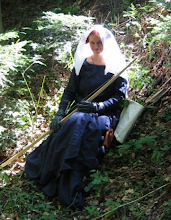



Finally, all things necessary have come together: The wood that I need, the machines and tools that I need, and the lovely upstairs neighbour with time on his hands to show me how to use the machines. So on the weekend, I started work on the new wool wheel.
As German strategist von Moltke once said, "No battle plan survives contact with the enemy" - I have already made some changes to the plan that I drew in meticulous work. The board that will carry all the rest of the wheel has gotten somewhat slimmer (so that it could fit into the planing machine), and it's not all even (though that does not bother me a bit), and it's about 5 cm shorter than intended originally. But all that is no big deal, since the plan was more or less drawn after a Psalter illumination and part of the plan was to adjust as necessary.
In addition to the wheel, and in some way also to practice some of the procedures, I am also planning to build a crossbar-and-post tablet weaving "loom", which means a run to the hardware store today. And the loom will come in very, very handy for my latest weaving project which will also travel with me to the RGZM in two weeks. Fortunately, the thing is an utterly simple affair... rendered even simpler by my planning on how to build it.
Showing posts with label planning. Show all posts
Showing posts with label planning. Show all posts
Monday, 4 June 2012


Thursday, 11 March 2010
I'm working on it.
If you want to know what "it" is today, it's both the Call for Papers/Call for Workshops for this year's Textile Forum as well as the tent for the market stall.
Writing the call for takes so long because, well, there are quite a few changes in comparison to last year, and we don't want to give a wrong impression by hastily written information.
And making the tent... well, everybody who has ever planned the construction of a tent/stall and then sewn that tent by hand knows how long that can take. Add to this the additional problems and challenges popping up - like the waterproofing issue - and it's no wonder that progress is slow. But it is there. After taking a nice, hot bath

the tent fabric is now completely dry again, and today it's time to test the construction basics by putting up the "framework". Most of the connections for putting up the wooden part will be temporary and provisional, since the tent structure has no stand-alone, rigid framework, but relies on combining wood and fabric. But I need to get a proper, hands-on evaluation of how large the inner space will feel in the completed tent, and I also need to mark where to put diverse bits and pieces for the construction on the fabric. So up it must go.
Writing the call for takes so long because, well, there are quite a few changes in comparison to last year, and we don't want to give a wrong impression by hastily written information.
And making the tent... well, everybody who has ever planned the construction of a tent/stall and then sewn that tent by hand knows how long that can take. Add to this the additional problems and challenges popping up - like the waterproofing issue - and it's no wonder that progress is slow. But it is there. After taking a nice, hot bath

the tent fabric is now completely dry again, and today it's time to test the construction basics by putting up the "framework". Most of the connections for putting up the wooden part will be temporary and provisional, since the tent structure has no stand-alone, rigid framework, but relies on combining wood and fabric. But I need to get a proper, hands-on evaluation of how large the inner space will feel in the completed tent, and I also need to mark where to put diverse bits and pieces for the construction on the fabric. So up it must go.
Monday, 8 March 2010
Make it proofed - waterproofed.
As spring is creeping in and battling hard with the remainders of the winter, the weather is getting nicer and nicer and season start is rushing towards us, I still have to finish my new market stall. It is coming along - yesterday was bathing day, and the main part of the tent - almost four metres on seven metres - took a hot bath in our tub.
Now that it is getting closer to being a tent, one of the biggest concerns (my German expression of choice would be "die größten Bauchschmerzen" - literally "the biggest stomach ache") is how to get it waterproof. Seriously waterproof.
We bought heavy linen fabric in the hopes of it being waterproof due to its nature - some heavy fabric, pure linen, can soak up water and then get so dense and tight that it can be even used as a bucket. Totally waterproof. Unfortunately, it became very clear very soon that our specimen of heavy linen fabric is not like that. Yes, it is heavy, but the fibres will not swell up enough when soaked in water to get it completely impermeable to water, and thus I need some additional waterproofing method.
And that's my problem. I want to have the tent/stall as accurate as possible, but I will draw a line at non-secure waterproofiness. I need my goods (and myself, but the goods for selling are more important here) to stay dry no matter how hard it rains. And I am willing to compromise if this needs some modern trick - though I would prefer a period way.
So there are some possibilities now that I have already found, among them using linseed oil varnish; using oil paint from linseed oil varnish with a pigment/filler mixed in to paint the tent much as an oil-cloth (with the added bonus of decorative possibilities); using store-bought waterproofing liquids; it would even be a possibility to buy silicone at the hardware store and "paint" the cloth with that. I'm still undecided, I would like to test each of the methods but I am shying away a little from buying all of those things for a small test scrap of fabric, and am generally feeling quite uneasy about this part of the project.
And I'd be very happy about any input that you might be able to give.
Now that it is getting closer to being a tent, one of the biggest concerns (my German expression of choice would be "die größten Bauchschmerzen" - literally "the biggest stomach ache") is how to get it waterproof. Seriously waterproof.
We bought heavy linen fabric in the hopes of it being waterproof due to its nature - some heavy fabric, pure linen, can soak up water and then get so dense and tight that it can be even used as a bucket. Totally waterproof. Unfortunately, it became very clear very soon that our specimen of heavy linen fabric is not like that. Yes, it is heavy, but the fibres will not swell up enough when soaked in water to get it completely impermeable to water, and thus I need some additional waterproofing method.
And that's my problem. I want to have the tent/stall as accurate as possible, but I will draw a line at non-secure waterproofiness. I need my goods (and myself, but the goods for selling are more important here) to stay dry no matter how hard it rains. And I am willing to compromise if this needs some modern trick - though I would prefer a period way.
So there are some possibilities now that I have already found, among them using linseed oil varnish; using oil paint from linseed oil varnish with a pigment/filler mixed in to paint the tent much as an oil-cloth (with the added bonus of decorative possibilities); using store-bought waterproofing liquids; it would even be a possibility to buy silicone at the hardware store and "paint" the cloth with that. I'm still undecided, I would like to test each of the methods but I am shying away a little from buying all of those things for a small test scrap of fabric, and am generally feeling quite uneasy about this part of the project.
And I'd be very happy about any input that you might be able to give.
Tuesday, 20 October 2009
Things happening
Quite a lot is going on behind the scenes here, not least of all the fact that we have started actual work on the new market stall. The first bit of cloth has been cut and now takes up space in our living room, lying around and looking innocent (as far as 30 square metres of cloth can look innocent, that is). Now we only need to sew one long line of about 7.5 metres before it's time to shrink and waterproof this part.
The wood is already in the basement (mostly - one bit is missing), and after the long piece we're at now is sewn together and treated, the wood structure can be inserted and the fixings made. But it will take a few more evenings of needlework until that is the case!
Another thing happening is my collecting of ideas for some more textile tools for the market stall. I'm thinking of more accessories and tools for goldwork and embroidery - so if you have any suggestions or wishes, let me know, and maybe I'll be inspired to include it.
The wood is already in the basement (mostly - one bit is missing), and after the long piece we're at now is sewn together and treated, the wood structure can be inserted and the fixings made. But it will take a few more evenings of needlework until that is the case!
Another thing happening is my collecting of ideas for some more textile tools for the market stall. I'm thinking of more accessories and tools for goldwork and embroidery - so if you have any suggestions or wishes, let me know, and maybe I'll be inspired to include it.
Wednesday, 23 September 2009
Market Stall Organisation
While working on the real wood-and-cloth market stall, thinking about the selection and presentation of goods and working simultaneously on the "market stall" website, I'm pondering how to sort and how to present the goods on the website - and what and how much information to provide with each piece.
I carry a few replicas - like the spindle sticks, the netting needles, naturally dyed silk threads, and so on. However, I don't have "perfect" replicas for sale in the sense of the original material is used for the replicas (the correct metal, the correct wood) and that they are made using only medieval tools and methods (and that would be really pricey). In addition, I carry some goods that are part or complete conjecture - I have pincushions to keep pins and needles safe, I have parchment tablets for weaving. And finally, there are some things that are first seen later than the middle ages, like the "Nähsteine", where I'm actually not sure whether they were not used before the 17th or 18th century or whether usage was just so normal/unspectacular that they are not shown on the few pictures that we have from medieval sewing work.
When people come to me on the market to buy real-life, they can just ask and I can explain and discuss things with them. In the internet - not so easy. It is of course possible to mail or phone, but takes significantly more effort to do so.
So the big question is: Do I need to write the story behind each of the objects on the market stall webpage? Or would nobody care? Do you, as buyer of things as LH equipment want to know exactly what, where, when, why? (Personally, I would.) Comments and input, anyone?
I carry a few replicas - like the spindle sticks, the netting needles, naturally dyed silk threads, and so on. However, I don't have "perfect" replicas for sale in the sense of the original material is used for the replicas (the correct metal, the correct wood) and that they are made using only medieval tools and methods (and that would be really pricey). In addition, I carry some goods that are part or complete conjecture - I have pincushions to keep pins and needles safe, I have parchment tablets for weaving. And finally, there are some things that are first seen later than the middle ages, like the "Nähsteine", where I'm actually not sure whether they were not used before the 17th or 18th century or whether usage was just so normal/unspectacular that they are not shown on the few pictures that we have from medieval sewing work.
When people come to me on the market to buy real-life, they can just ask and I can explain and discuss things with them. In the internet - not so easy. It is of course possible to mail or phone, but takes significantly more effort to do so.
So the big question is: Do I need to write the story behind each of the objects on the market stall webpage? Or would nobody care? Do you, as buyer of things as LH equipment want to know exactly what, where, when, why? (Personally, I would.) Comments and input, anyone?
Wednesday, 22 July 2009
Guessing the Market
There's sort of good news: Finally, I might have found an artisan who is capable and willing to reproduce medieval gold thread for me. Real, no-compromise gold thread, as it was found in the excavations at Villach-Judendorf in Austria: Gilt silver wound around a natural-coloured silk "soul", 0,2 mm thick and used for weaving (brocade) as well as for embroidery. (You can use several threads at once when doing couch work - I have a nice photo somewhere showing just that. After all, medieval people had their lazy streak too!)
"Normal" gilt or gold threads are imitation gold, wound around a core of cellulose or other material, but not around silk. And getting gilt-silver threads (not the japanese version, where a strip of paper is gilded or silvered) is really hard already, even if it's "just" gilt, not pure gold. Those threads are usually much thicker, too.
The downside? There's a hefty minimum order, and gold thread is not cheap. Quite the opposite, actually: Real gold or gilt thread was exquisitely expensive in the Middle Ages and it's still exquisitely expensive today. I'm very, very tempted to order the thread, but it's an investment that should not go too wrong.
So now it's time for me to play my most beloved game of them all (well, not really): "Guess The Market". And this time, I'm shamelessly using this blog to get some input from you, because I've been told time and again that I'm no normal textile stuff customer (though you probably aren't).
Do you feel the strong desire to buy authentic-to-the-soul gold thread? Modeled after a find? Even if it is really thin and really pricey? Would you use it for weaving, for embroidery, or for both? How much need do you have? And how much would you be willing to pay for, say, 10 metres? Or do you prefer to buy the cheaper imitation gold thread?
"Normal" gilt or gold threads are imitation gold, wound around a core of cellulose or other material, but not around silk. And getting gilt-silver threads (not the japanese version, where a strip of paper is gilded or silvered) is really hard already, even if it's "just" gilt, not pure gold. Those threads are usually much thicker, too.
The downside? There's a hefty minimum order, and gold thread is not cheap. Quite the opposite, actually: Real gold or gilt thread was exquisitely expensive in the Middle Ages and it's still exquisitely expensive today. I'm very, very tempted to order the thread, but it's an investment that should not go too wrong.
So now it's time for me to play my most beloved game of them all (well, not really): "Guess The Market". And this time, I'm shamelessly using this blog to get some input from you, because I've been told time and again that I'm no normal textile stuff customer (though you probably aren't).
Do you feel the strong desire to buy authentic-to-the-soul gold thread? Modeled after a find? Even if it is really thin and really pricey? Would you use it for weaving, for embroidery, or for both? How much need do you have? And how much would you be willing to pay for, say, 10 metres? Or do you prefer to buy the cheaper imitation gold thread?
Tuesday, 14 July 2009
Can't be too thin, really!
I've been sewing for ages now with Gütermann Silk thread (the thread on the blue plastic spool) whenever I needed sewing silk. Why? Because it's available in almost every second sewing shop around here. But a few things did irk me about it. First of all, it's on a blue plastic spool - that makes it easy to tell the silk thread from the cotton and polyester variations coming on the same spool type, but not so easy to use the thread on medieval events. Then it is - of course - coloured chemically. And then it's just so thick and bulky! Fine for tablet weaves, but for sewing really fine silk? Nah. And for authentic hairnets, too, it's just too thick.
So a while ago, I found out about YLI silks - the sort they call "Silk 100", to be precise. It comes on plastic spools (white and quite short-and-thick, this time) and is much lankier than Gütermann. So I was happier for a while - but the plastic spool problem still applies (and I was not about to re-wind 200 metres of fine silk thread from a plastic spool to a wooden one, I'm one of those rather hiding their spools). And while YLI says it's the finest silk thread on the market, it is still a little thick for making hairnets. And while we're at it, I'd like a finer thread for the really fine stitching on thin silks (think Pongé 05 quality here) and for couching works or sewing something on "invisible". So now YLI is not the thinnest thread on the market anymore, at least not on the medieval markets!

Here you see from left to right: All the money I will have left after investing in this market stall, Gütermann sewing-quality white silk thread, YLI Silk 100 in white, and my extra-thin silk.
It will come wound in portions on paper cores, so while it is not properly medieval, it's at least not plastic. The thread is fine for making hairnets, attaching small embroideries to a garment, for using as weft thread in tablet weaving with thicker silks if you would like your motifs a little less lengthened, or for stitching really fine silks or - of course - couching work. The only thing left to decide for me now is how much of the thread to use for one portion: one hundred metres? two hundred metres? More or less?
So a while ago, I found out about YLI silks - the sort they call "Silk 100", to be precise. It comes on plastic spools (white and quite short-and-thick, this time) and is much lankier than Gütermann. So I was happier for a while - but the plastic spool problem still applies (and I was not about to re-wind 200 metres of fine silk thread from a plastic spool to a wooden one, I'm one of those rather hiding their spools). And while YLI says it's the finest silk thread on the market, it is still a little thick for making hairnets. And while we're at it, I'd like a finer thread for the really fine stitching on thin silks (think Pongé 05 quality here) and for couching works or sewing something on "invisible". So now YLI is not the thinnest thread on the market anymore, at least not on the medieval markets!

Here you see from left to right: All the money I will have left after investing in this market stall, Gütermann sewing-quality white silk thread, YLI Silk 100 in white, and my extra-thin silk.
It will come wound in portions on paper cores, so while it is not properly medieval, it's at least not plastic. The thread is fine for making hairnets, attaching small embroideries to a garment, for using as weft thread in tablet weaving with thicker silks if you would like your motifs a little less lengthened, or for stitching really fine silks or - of course - couching work. The only thing left to decide for me now is how much of the thread to use for one portion: one hundred metres? two hundred metres? More or less?
Monday, 13 July 2009
Textilforum Again
Things are also progressing with the Textilforum planning, even if there was a long silence in the last weeks. The metal "cookie cutters" for making the experiment spinning whorls are in production, the wool is already waiting for September, and while there is quite a lot still to prepare for the experiment, there seems to be no catastrophe lurking around the next corner.
There's also progress on other parts; we now have two very interesting lectures for each evening programme, covering a variety of aspects; so one of the things on my to-do-list today is getting the Forum website up to date and mailing around to keep people informed...
There's also progress on other parts; we now have two very interesting lectures for each evening programme, covering a variety of aspects; so one of the things on my to-do-list today is getting the Forum website up to date and mailing around to keep people informed...
Tuesday, 30 June 2009
Tents and Stalls
Though really beautiful, our current tent is not very well suited to show-and-tell or sale of goods on medieval markets or events. So I'm saddled with the need for an additional market stall to take with me when I'm on my own for a market. And that, as usual, brings all sorts of problems.
First of all, the medieval markets we have here today are mostly show-events for the enjoyment of visitors, both contemporary and LH*-visitors, while a more comparable event to the real medieval markets/fairs would probably be a modern (business) fair or one of the old-fashioned "Jahrmärkte" where there are mostly stalls selling things and only some muncheonettes and very, very few amusement rides (like a carousel for children, and that's it). So for the medieval market, there is a lot of logistic but very, very varying sales figures for the sellers (while stuff to munch on is always bought).
Today's medieval markets are roughly split into two sorts of events: Those for the modern visitors and those for the LH folks. Both types are, of course, frequented by both groups, but usually an event has its focus on one of the groups. Markets for modern visitors will either offer information (or should I write infotainment, since it is usually perceived as entertaining) and a few goods for sale (that might or might not be on sale for actually selling a lot, but also for displaying things on offer in the middle ages). That is a good visitor-oriented market. If it's a bad one, it looks a bit like Disneyland trying to go into the past: Usually some non-medieval music somewhere, foodbooths liberally using potatoes and other modern food, and the stalls are obviously geared towards selling Hollywood-medievalistic-seeming trinkets to unsuspecting visitors. Sprinkle this with a generous serving of bad clothes, clichés and misinformation, and you are done. These can be a really bad experience.**
Markets geared towards LH folks ("Lagermärkte" in German) usually have lots of non-selling LH people there for their enjoyment and a large market area with booths and stalls selling mostly things needed (or wanted) for LH purposes. Those events are where you can buy naturally dyed cloth and yarn, hand-made copper-alloy pins and needles, buckles and brooches, boxes from wood, plates, beakers, glasswares, leatherwares, you name it. Target buyers for the stalls are mostly LH participants and visitors. In case you ever wondered, this is where we do lots of our shopping, planning, and drooling over things too expensive, not in our time or not in our status range, but still so beautiful they are worth sighing over.
So the LH markets are more like a modern business fair in some respect and as such closer to the real medieval market (probably minus the hundreds of large tents on the camp areas). And like the sellers going to the markets a few hundred years ago, today's sellers are faced with rather large logistics problems.
As a seller, you need a place and way to present the goods and some space to sleep. You need to hide your own clothes and paraphernalia somewhere (like a chest or covered basket), you need to bring decoration and, of course, the goods. All that stuff has to fit into a vehicle for transport and you have to be able to set up your tent or stall in an adequate time and preferably without lots of helpers. And for those who like it authentic today, there's not too much documentation.
Since bringing stalls would have been a huge logistic effort in the middle ages, but stalls are regularly seen on pictures, I'm wondering - were those stalls semi-permanent fixtures, set up in spring and taken down after the last market in autumn? Were they stalls of regular market sellers from the region? Did sellers for a larger market with wider catchment area bring their own stalls and booths? Everything - cloth and wood - or just the cloth, cutting the wood parts from nearby? Did they bring cooking gear (I'd doubt it) or did they buy their food? And how did the stalls look like? What worked for what kind of profession or offered goods?
While I'm wondering about that, I'm trying to design a stall that will at least look plausible to the not-too-critical eye. And meets my requirements: Fits in the car (this limits the maximum length of the poles); is made of cloth, wood and leather with little or no metal; can be closed completely for nights and for bad weather; small yet offering enough space to display/sell, show-and-tell and sleep; cloth from linen, tightly woven so no water comes through, and half-bleached for enough light inside the stall; with a crossbeam for hanging garments in the typical medieval way of garment presentation at a tailor shop; and if at all possible, can be set up by me on my own (which also limits total height, since I cannot reach higher than 2,15 m without something to stand on.
So after a lot of planning and great fun while tinkering (and even fun doing the maths required), I present to you: My model of the future market stall. The small chopstick figure beside the table, that's me, and the tall chap (or chop?) is a 2 metre tall visitor (who had to duck a tiny bit for coming in). It doesn't have the side parts, of course, but there's a crossbeam with a dress hanging over it and my future table with a display stand on it and there's even a curtain to close off a little space for sleeping and storing stuff in the back. And all on the rather small footprint of ca. 2,5 on 2,5 metres. I like it!

* Living History, of course. I warned you several times in this blog that I'm lazy, didn't I?
**Unfortunately, it's hard to tell which kind it will be just from reading "Medieval Market There and Then" on a poster. There could be money made with a detector, I guess...
First of all, the medieval markets we have here today are mostly show-events for the enjoyment of visitors, both contemporary and LH*-visitors, while a more comparable event to the real medieval markets/fairs would probably be a modern (business) fair or one of the old-fashioned "Jahrmärkte" where there are mostly stalls selling things and only some muncheonettes and very, very few amusement rides (like a carousel for children, and that's it). So for the medieval market, there is a lot of logistic but very, very varying sales figures for the sellers (while stuff to munch on is always bought).
Today's medieval markets are roughly split into two sorts of events: Those for the modern visitors and those for the LH folks. Both types are, of course, frequented by both groups, but usually an event has its focus on one of the groups. Markets for modern visitors will either offer information (or should I write infotainment, since it is usually perceived as entertaining) and a few goods for sale (that might or might not be on sale for actually selling a lot, but also for displaying things on offer in the middle ages). That is a good visitor-oriented market. If it's a bad one, it looks a bit like Disneyland trying to go into the past: Usually some non-medieval music somewhere, foodbooths liberally using potatoes and other modern food, and the stalls are obviously geared towards selling Hollywood-medievalistic-seeming trinkets to unsuspecting visitors. Sprinkle this with a generous serving of bad clothes, clichés and misinformation, and you are done. These can be a really bad experience.**
Markets geared towards LH folks ("Lagermärkte" in German) usually have lots of non-selling LH people there for their enjoyment and a large market area with booths and stalls selling mostly things needed (or wanted) for LH purposes. Those events are where you can buy naturally dyed cloth and yarn, hand-made copper-alloy pins and needles, buckles and brooches, boxes from wood, plates, beakers, glasswares, leatherwares, you name it. Target buyers for the stalls are mostly LH participants and visitors. In case you ever wondered, this is where we do lots of our shopping, planning, and drooling over things too expensive, not in our time or not in our status range, but still so beautiful they are worth sighing over.
So the LH markets are more like a modern business fair in some respect and as such closer to the real medieval market (probably minus the hundreds of large tents on the camp areas). And like the sellers going to the markets a few hundred years ago, today's sellers are faced with rather large logistics problems.
As a seller, you need a place and way to present the goods and some space to sleep. You need to hide your own clothes and paraphernalia somewhere (like a chest or covered basket), you need to bring decoration and, of course, the goods. All that stuff has to fit into a vehicle for transport and you have to be able to set up your tent or stall in an adequate time and preferably without lots of helpers. And for those who like it authentic today, there's not too much documentation.
Since bringing stalls would have been a huge logistic effort in the middle ages, but stalls are regularly seen on pictures, I'm wondering - were those stalls semi-permanent fixtures, set up in spring and taken down after the last market in autumn? Were they stalls of regular market sellers from the region? Did sellers for a larger market with wider catchment area bring their own stalls and booths? Everything - cloth and wood - or just the cloth, cutting the wood parts from nearby? Did they bring cooking gear (I'd doubt it) or did they buy their food? And how did the stalls look like? What worked for what kind of profession or offered goods?
While I'm wondering about that, I'm trying to design a stall that will at least look plausible to the not-too-critical eye. And meets my requirements: Fits in the car (this limits the maximum length of the poles); is made of cloth, wood and leather with little or no metal; can be closed completely for nights and for bad weather; small yet offering enough space to display/sell, show-and-tell and sleep; cloth from linen, tightly woven so no water comes through, and half-bleached for enough light inside the stall; with a crossbeam for hanging garments in the typical medieval way of garment presentation at a tailor shop; and if at all possible, can be set up by me on my own (which also limits total height, since I cannot reach higher than 2,15 m without something to stand on.
So after a lot of planning and great fun while tinkering (and even fun doing the maths required), I present to you: My model of the future market stall. The small chopstick figure beside the table, that's me, and the tall chap (or chop?) is a 2 metre tall visitor (who had to duck a tiny bit for coming in). It doesn't have the side parts, of course, but there's a crossbeam with a dress hanging over it and my future table with a display stand on it and there's even a curtain to close off a little space for sleeping and storing stuff in the back. And all on the rather small footprint of ca. 2,5 on 2,5 metres. I like it!

* Living History, of course. I warned you several times in this blog that I'm lazy, didn't I?
**Unfortunately, it's hard to tell which kind it will be just from reading "Medieval Market There and Then" on a poster. There could be money made with a detector, I guess...
Monday, 29 June 2009
Monday, Fun day!
I had a really nice weekend, including a wonderfully productive and fulfilling Friday and Saturday. Much of Friday was spent chatting and plotting things with two fellow archaeologists - one of them in personal union the goldsmith making my netting needles. So on that afternoon, a few more ideas developed for the range of goods for me to carry. The stall is developing into something catering to textile workers and enthusiasts of all textile disciplines current in the middle ages: Tailoring and sewing, narrow wares, netting, embroidery, and some more odds and ends. I won't carry fibres (since there are enough people for that, and most textile folks already have one or more sources for fibre), but odds, ends, and things connected to stitching and textile crafts.
Since the visit on Friday, I now have six more netting needles, as tools when holding workshops or for sale. They are just as beautiful and just as polished as my own one, and here's proof:

And just because of that incredible net from St.-Truiden, I had also ordered a really small netting needle. Really really small. And here it is, made from copper wire, with a shank diameter of a gigantic full millimetre! I'm really delighted with it, and I will try it out with my new, extra-fine silk thread - another thing that will be offered for sale.

I talked about a really productive weekend, didn't I? Saturday morning gave me a head start on something nice and special for the embroidery fraction, though that idea is still under development and therefore still top secret. The wood for the netting gauges is standing in the living room, waiting to be cut into pieces and sanded down. The concept for the stall is also developing - but more about all those things in another post...
Since the visit on Friday, I now have six more netting needles, as tools when holding workshops or for sale. They are just as beautiful and just as polished as my own one, and here's proof:

And just because of that incredible net from St.-Truiden, I had also ordered a really small netting needle. Really really small. And here it is, made from copper wire, with a shank diameter of a gigantic full millimetre! I'm really delighted with it, and I will try it out with my new, extra-fine silk thread - another thing that will be offered for sale.

I talked about a really productive weekend, didn't I? Saturday morning gave me a head start on something nice and special for the embroidery fraction, though that idea is still under development and therefore still top secret. The wood for the netting gauges is standing in the living room, waiting to be cut into pieces and sanded down. The concept for the stall is also developing - but more about all those things in another post...
Monday, 8 June 2009
Feeling lonely?
It's been ages since I last posted about the Textilforum, so it's high time. And I have a reason, too: We have extended the deadline for registration to June 30. There are still some spaces left for participants at the museum, so if your occupation includes historical textile crafts - research, reconstruction, analysis, conservation, replicating - you are welcome to join us at the Forum. We also need a few more handspinners (handspindle only) to make the required twenty that we need for the spinning experiment. If you are a handspinner and able to spin an even thread for two hours, you could be part of this nifty bit of science!
If you don't know what I'm talking about: The Textilforum is intended to get people working with historical textile crafts into contact with each other - because it can be a very lonely affair. So we would like to link both professionals and amateurs (like living history folks) in this Forum, where there will be ample time to work, chat, and exchange hints and tips with each other. There will be some programme provided - presentations about research or projects in the evenings - and we'll run an archaeological experiment, the spinning experiment, during the mornings. The rest of time is free; think "gigantic enormous conference coffee break".
You can read more about the Forum on our website, www.textilforum.org, and you can also register there: Go to Call for Papers site, and on the bottom, you will find the link for registration. See you in Eindhoven!
Oh, and you can read me here again next week - I'm off for a few days' vacation, before summer work stress really hits...
If you don't know what I'm talking about: The Textilforum is intended to get people working with historical textile crafts into contact with each other - because it can be a very lonely affair. So we would like to link both professionals and amateurs (like living history folks) in this Forum, where there will be ample time to work, chat, and exchange hints and tips with each other. There will be some programme provided - presentations about research or projects in the evenings - and we'll run an archaeological experiment, the spinning experiment, during the mornings. The rest of time is free; think "gigantic enormous conference coffee break".
You can read more about the Forum on our website, www.textilforum.org, and you can also register there: Go to Call for Papers site, and on the bottom, you will find the link for registration. See you in Eindhoven!
Oh, and you can read me here again next week - I'm off for a few days' vacation, before summer work stress really hits...
Wednesday, 3 June 2009
Oh, do we have a video?
For the exhibition next month in Bad Staffelstein, we have planned to install a TV somewhere in the rooms and show some video snippets of textile techniques there - because if you've never seen a handspindle before, you can probably not imagine how it looks being used and how it works. So today is the day that we will make the video for the snippets - thank goodness for friends who are always helpful!
I'm planning to do spinning, netting, tablet weaving (showing some twill sequences) and a bit of fingerloop braiding. I hope we can get all this done, and I have to get buzzing now to prepare everything so it won't take too long to change technique.
And I still have to decide whether to wear modern or medieval clothing...
I'm planning to do spinning, netting, tablet weaving (showing some twill sequences) and a bit of fingerloop braiding. I hope we can get all this done, and I have to get buzzing now to prepare everything so it won't take too long to change technique.
And I still have to decide whether to wear modern or medieval clothing...
Friday, 29 May 2009
Netting Needles, hooray!
I've been busy with some scheming, and it looks as if I'll be able to teach netting soon in the future. We have found some material to work netting needles that does not involve hours and hours of hammering a thick rod down into a thin rod, and thus needles can be made that won't cost a fortune. The first two of the new generation are still unpolished but about finished otherwise...
Beautiful tools, made after a proper source (an archaeological find from London), to spread again knowledge about an old, beautiful textile technique - what's not to love?
Beautiful tools, made after a proper source (an archaeological find from London), to spread again knowledge about an old, beautiful textile technique - what's not to love?
Wednesday, 27 May 2009
What's this with conference deadlines?
The deadline for the Textilforum Call for Papers is officially over. But... there are still places left. We have planned for 50 persons staying in at the museum (and I do think it's a good deal, even if you have to bring your own bedding), and I had thought that we would have no problem filling these places. Heck, there have been so many positive comments all over, I was sure we'd have no problem.
I know that it is a common thing to extend conference CfP deadlines, and I also know that I'm one of those people registering in the last week before deadline (or even on the last day). And that it can happen that I miss a deadline, too. So we'll extend our deadline to fill some more of the places.
However, I'm wondering why there have been so few registrees. Is it my fault? Has the wording been bad? Is the participant questionnaire too hard to find? Does it sound as if we don't want people to come? Maybe it sounds as if you have to give a paper or bring a poster or else you can't come? While we appreciate paper/poster offers, these are no absolute requirement. So if you are an archaeologist, conservator, hand weaver, hand spinner, historical textile person and have an interest in historical textile techniques, come join us! And we still need spinners for our experiment, too - so if you are a handspinner and would like to participate in the spinning experiment, do fill out the questionnaire and come have fun doing science!
I know that it is a common thing to extend conference CfP deadlines, and I also know that I'm one of those people registering in the last week before deadline (or even on the last day). And that it can happen that I miss a deadline, too. So we'll extend our deadline to fill some more of the places.
However, I'm wondering why there have been so few registrees. Is it my fault? Has the wording been bad? Is the participant questionnaire too hard to find? Does it sound as if we don't want people to come? Maybe it sounds as if you have to give a paper or bring a poster or else you can't come? While we appreciate paper/poster offers, these are no absolute requirement. So if you are an archaeologist, conservator, hand weaver, hand spinner, historical textile person and have an interest in historical textile techniques, come join us! And we still need spinners for our experiment, too - so if you are a handspinner and would like to participate in the spinning experiment, do fill out the questionnaire and come have fun doing science!
Wednesday, 20 May 2009
Cover up...
The time has come to think about the cover of the book, and I'm not all sure what direction to choose. It should have something to do with tailoring, preferably - so do I try to find a medieval picture of a tailor's workshop? Or do I use a photograph of modern replicas for tailoring - pins, needles, shears, fabric, spools of thread? As a still-life or in action, with more or less of somebody working visible? Or a collage, mixing a medieval picture with the photograph?
Any suggestions, gentle readers? What would you expect or prefer on a book whose title says something on the lines of "Construction and sewing technique of secular medieval garments"?
Any suggestions, gentle readers? What would you expect or prefer on a book whose title says something on the lines of "Construction and sewing technique of secular medieval garments"?
Wednesday, 13 May 2009
Progress?
Planning for the spinning experiment is still going on - there are a lot of things to consider, including how to extract the data out of all those yarns spun during the experiment time. A part of yesterday was spent doing test spinnings with all the test whorls I have made for the experiment. I found them all to be more or less workable, though some felt really, really awkward.
Then there's a paper to finish that is somehow not really willing to be finished. I'm glad (for a change) that the deadline for this is coming closer and closer, so there's only so long I can procrastinate by taking care of the hundred other odds and ends on my list. Including the daily blog - so time to rush off to that word processor.
Then there's a paper to finish that is somehow not really willing to be finished. I'm glad (for a change) that the deadline for this is coming closer and closer, so there's only so long I can procrastinate by taking care of the hundred other odds and ends on my list. Including the daily blog - so time to rush off to that word processor.
Tuesday, 12 May 2009
Spinning Experiment Calculations
In preparation for the spinning experiment on the Textilforum, I need to figure out how much fibres to calculate for each participant. And to get a first impression, I spun with the carded and combed wool I have at hand - one hour in my normal thickness, and another hour as thick as I could manage.
Now I'm one of those people who have a very limited range of thickness when spinning. And (unfortunately for this purpose) it is rather on the fine side. So I ended up with two very different-sized balls of yarn; I wound them off today and weighed them with my letter scales.
The "Thick Yarn" weighs in at about 8 g for one hour's spinning time. It is pretty uneven, in spite of my trying oh-so-hard to spin a decently smooth and even yarn. Thick stuff is just not for me. Here you see the sorry results of my thick-spinning:

Beside the huge (haha), bulky and uneven ball of thick yarn, you can see what I spun as my normal thin yarn. The weight? Somewhere between one and two grammes. Both yarns spun with the same wool on the same spindle (which was about double the weight of the reference whorl for the experiment, and fitted with a rather heavy wooden spindle stick). When wound onto a ruler, the thick wool gives about 20 threads per inch, the thin one about 12 threads per quarter-inch.
So now I've outed myself as a thin-spinning freak, can any spinners of thick yarn out there give me a rough estimate of how much fiber in grammes they hand-spindle away in one hour? Just to check against my calculations? I'd be very grateful...
Now I'm one of those people who have a very limited range of thickness when spinning. And (unfortunately for this purpose) it is rather on the fine side. So I ended up with two very different-sized balls of yarn; I wound them off today and weighed them with my letter scales.
The "Thick Yarn" weighs in at about 8 g for one hour's spinning time. It is pretty uneven, in spite of my trying oh-so-hard to spin a decently smooth and even yarn. Thick stuff is just not for me. Here you see the sorry results of my thick-spinning:

Beside the huge (haha), bulky and uneven ball of thick yarn, you can see what I spun as my normal thin yarn. The weight? Somewhere between one and two grammes. Both yarns spun with the same wool on the same spindle (which was about double the weight of the reference whorl for the experiment, and fitted with a rather heavy wooden spindle stick). When wound onto a ruler, the thick wool gives about 20 threads per inch, the thin one about 12 threads per quarter-inch.
So now I've outed myself as a thin-spinning freak, can any spinners of thick yarn out there give me a rough estimate of how much fiber in grammes they hand-spindle away in one hour? Just to check against my calculations? I'd be very grateful...
Thursday, 23 April 2009
Crazy busy
After yesterday's crazy business, today is going to be at least as busy. I have already stacked material and pre-cut material that I'll take with me tomorrow, have almost finished the obligatory name-and-company-name plaque that you have to hang on a stall by German law, and now I'm sitting writing price tags and price lists.
I'm all tensed up about how the market will go. It's the first time I actually sell (or try to sell) stuff that I haven't made to order (and to measure) myself. I have some superfine silk threads to sell, and I have managed to get my hands on a few spools of real gold thread for couching or brocading weaves. I'm so, so curious whether any of this will sell! I know that I would be all over the stuff, so it remains to find out how many others like me are roaming the market.
Oh, and just before going to bed yesterday, we found that we still have enough material left from sewing our tent to add some sort of a tarp to our equipment. Designing was done in the kitchen, between quarter to and half past eleven. Including the walk into the cellar to check how much fabric there is left. That was fun!
I'm all tensed up about how the market will go. It's the first time I actually sell (or try to sell) stuff that I haven't made to order (and to measure) myself. I have some superfine silk threads to sell, and I have managed to get my hands on a few spools of real gold thread for couching or brocading weaves. I'm so, so curious whether any of this will sell! I know that I would be all over the stuff, so it remains to find out how many others like me are roaming the market.
Oh, and just before going to bed yesterday, we found that we still have enough material left from sewing our tent to add some sort of a tarp to our equipment. Designing was done in the kitchen, between quarter to and half past eleven. Including the walk into the cellar to check how much fabric there is left. That was fun!
Tuesday, 21 April 2009
Preparing for the Weekend
There are still a lot of things left to do, and to add to the scarcity of time and the amount of things to do, I have to do a library run this week.
Today's the day to write a list with all the stuff I will take for the weekend and try getting some more sewing done - yesterday I got stuck at the computer all the time. One of the reasons was that the info-brochure for the Textilforum was due to go to the printer. It's finished now, I hope I didn't miss any errors in the proofing process, and I hope that the colours will turn out acceptably.
As current working projects, I have the dress, the hairnet, a hood that I can't continue working on at the moment since I am waiting for a pinking tool to arrive, and I started a tablet weave play band, contrary to all good intentions (but using as an excuse that I'm preparing a workshop on tablet weaving). There's stuff coming towards me by post - not only the brochures, but also yarns and the pinking tool, so I'm in a state of happy anticipation. And hope I can finish today's computer work before noon, so I can sit in the sun and sew...
Today's the day to write a list with all the stuff I will take for the weekend and try getting some more sewing done - yesterday I got stuck at the computer all the time. One of the reasons was that the info-brochure for the Textilforum was due to go to the printer. It's finished now, I hope I didn't miss any errors in the proofing process, and I hope that the colours will turn out acceptably.
As current working projects, I have the dress, the hairnet, a hood that I can't continue working on at the moment since I am waiting for a pinking tool to arrive, and I started a tablet weave play band, contrary to all good intentions (but using as an excuse that I'm preparing a workshop on tablet weaving). There's stuff coming towards me by post - not only the brochures, but also yarns and the pinking tool, so I'm in a state of happy anticipation. And hope I can finish today's computer work before noon, so I can sit in the sun and sew...
Thursday, 22 January 2009
Finally - a new date for the Textilforum!
It has taken us longer than we hoped to find a new date, but at last, the search was successful. Now we don't have a too tight schedule or an overlap with the planned dates of either of the two conflicting conferences, the EXAR conference 2009 in Hungary and the Conference for Archaeological Dyes and Dyeing.
The new date is even a bit earlier in the year, which hopefully means warmer and overall slightly better weather. The Textilforum will take place in the beautiful Open Air Museum in Eindhoven, Netherlands, from the 8th to 13th of September. If you are interested in historical textile crafts, this might be the place for you!
You can find more information at the forum website www.textilforum.org, where you can also subscribe for the forum newsletter, bringing you news and notice of updates of the site. Or contact me if you have questions.
The new date is even a bit earlier in the year, which hopefully means warmer and overall slightly better weather. The Textilforum will take place in the beautiful Open Air Museum in Eindhoven, Netherlands, from the 8th to 13th of September. If you are interested in historical textile crafts, this might be the place for you!
You can find more information at the forum website www.textilforum.org, where you can also subscribe for the forum newsletter, bringing you news and notice of updates of the site. Or contact me if you have questions.
Subscribe to:
Posts (Atom)