
Tuesday, 22 April 2014

Moar answers.

Doug asks
So maybe you have answered this before but I was wondering how you got involved in researching/making textiles.
I might have answered this before, but I actually can't remember - and since I have no idea on where to find the post, if such a one does exist...

It all started ages ago, when I was sweet seventeen years old. In a small village close to where I grew up, there was an annual "Ritterfest" (which is a medieval Festival thingie). One of my school comrades lived in that village, and she participated there, showing visitors how to make felt - so the next day, I dressed up in something not even vaguely historically correct and joined her, and the rest of the fun. I fell in love with the camaraderie and the bonfire evenings and hanging out and singing songs with other people around said fires that weekend. Shortly after, I started going to other, similar, events with a few people from that group... and that, of course, meant that I needed something to wear. The first piece I made for myself was a hood, by the way, and nothing I made back then was historically correct.

Fast forward about two years - time to decide what to do after school. After realising that the things I had thought about were not what I wanted to do after all, I sat down and made a list of stuff I would like to have included in my job. Things like being able to work outside, but also doing reading and desk work; maybe do something that involved other people; something practical, and something that had to do with the Middle Ages. When leafing through the Uni Guide, I stumbled across something that seemed to fit: Medieval Archaeology. And that's how I ended up in Bamberg. My parents were happy to support the choice I made, study-wise, and made it possible for me to become an archaeologist. (Thank you so much, you two!)

Back when I started my studies, going to medieval markets and similar events was still considered something a bit weird and thoroughly un-academic, much more so than these days. It was a growing trend, though, and I kept on going to these events, using them to try out garments and equipment pieces and crafts techniques. Now, however, I also had proper archaeological literature about medieval textiles, so my clothes did improve. (Over time - that was a longer process.) Textiles fascinated me more and more, and by the time I wrote my master's thesis, I was fully focused on textiles and clothing - a development I have never regretted.

And that is the full story of how I ended up researching garments and textile techniques - a teenage friend, a few lucky coincidences, some uni colleagues also interested in textiles who pointed me to books when I started out, and the opportunity to try out things and gain experience with cloth and clothing "in the wild", they all came together to make me insatiably curious to learn more about dress back then. (Hint: It hasn't lost any of its fascination on me yet.)



Thursday, 17 April 2014

Answers. To your questions.

Thank you for asking stuff in the post from two days ago, Suzanne and Marianne!

Regarding the Schnittbücher from the Kickstarter project, the Kickstarter books are scheduled to go out in June this year (though I wouldn't be at all surprised if it took considerably longer, knowing how things go in the publishing world). Marion says that they will be available  via Amazon US and DE after the rewards have gone out - so you will be able to get your copy.

And Suzanne asks about sewing techniques in 7th century. As far as I can tell, there are about the same stitches and techniques in use as for later sewing -with the exception of things like buttonholes, which were not yet so in vogue. There's a nice overview of sewing techniques published for the Haithabu finds (later than your intended period, though) and these are not too different from the later garments. There's not so much variation to be had for a straight seam, after all: running stitch seams and overcast seams are already found in the Hallstatt material from Bronze and Iron age.
7th century Frisians are, unfortunately, not very much in my core confidence zone either, and I can't think of any books with good textile finds from that era and region off the top of my head - sorry.

Wednesday, 16 April 2014

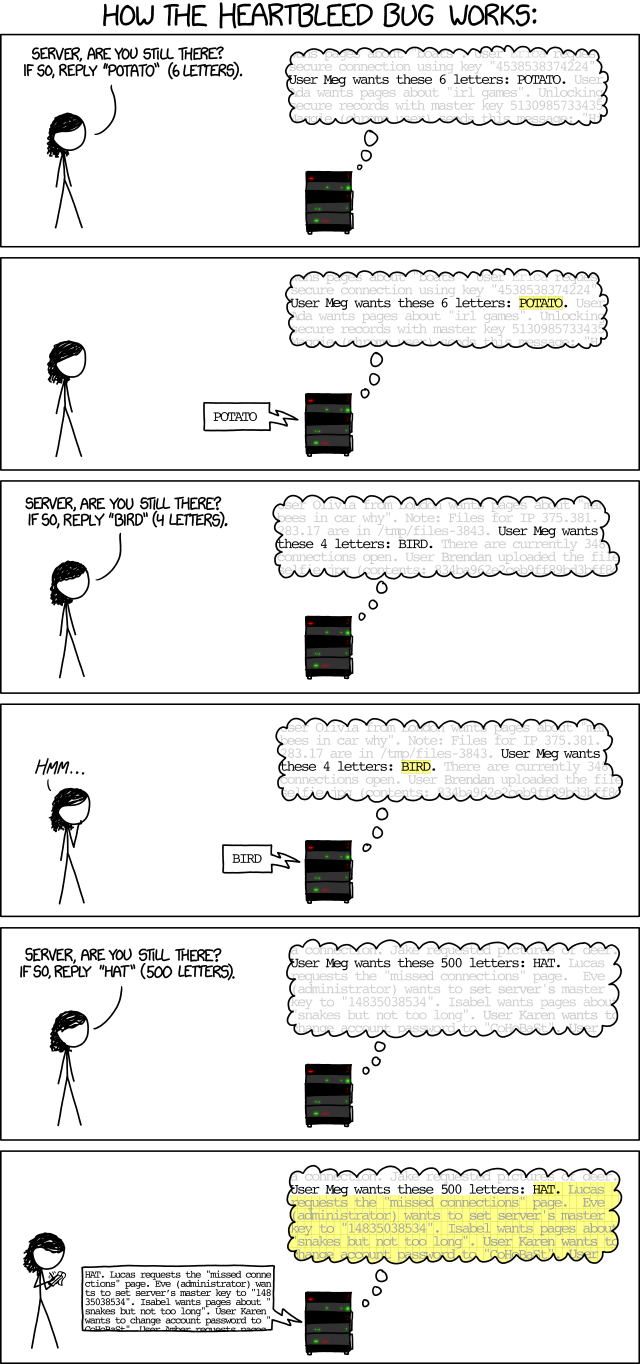
Heartbleed... have you changed your passwords yet?

If you haven't heard about it yet, there has been a flaw in the encryption protocols of Open SSL, and the so-called "Heartbleed bug" may have leaked personal information you had on these servers. So if you are using sites on the Internet that were affected (and who doesn't - Google is one of them) you might want to change your passwords.

Here's a list of affected sites; here is another one with a bit more explanation on how the bug was discovered (and links).

If you want the short and sweet explanation, here it is courtesy of XKCD:


On a totally different note - you can still ask me anything on yesterday's post. I'll keep checking for new questions until (and including) the Easter weekend. So go crazy!

Tuesday, 15 April 2014

Ask me anything!

I think it's time again for questions! I am pretty sure I did this before, but can't find the post anymore. So I'll make up new rules...

Ask me anything in the comments, and I will reply as well as I can. Exceptions are made if it's too personal, or if it will require in-depth research work, or involves a trade secret. Otherwise, I'll do my very best to answer your question.

So... anything you want to ask me?

Monday, 14 April 2014

Stuff on a Monday. Mostly coffee stuff, well, because? Monday.

How did the weekend pass so quickly? Is it really Monday again? Well, at least the overcast skies had the good grace to come today, not yesterday or Saturday, when we could enjoy some splendid weather, and I actually managed to get some gardening done.

Speaking of splendid - if you were thinking of moving to Stockholm, you might want to watch this ad video. Or if you like card tricks.


You can also get good coffee in Stockholm... I remember the first time I was in Scandinavia, I was totally amazed at the huge cups of really decent-to-totally-yummy coffee (with lots of milk) that you could get in any 7-11, or actually about anywere. Scandinavians run on coffee. Which seems to actually be healthy.

I didn't drink coffee until I was something in my twenties, when I slowly got fond of the taste, and now I do love a good cup of coffee, preferably with milk in it (lots of milk). A few years ago, we bought an Aeropress for our home, which is quick to use, makes lovely coffee, is easy to clean and does not take up much space. Like any German household, we have an electric water kettle to heat water anyway*, so it's one less appliance to find room and a socket for. Our coffee consumption, needless to say, has increased noticeably since introducing the Aeropress... small wonder.

Writing so much about coffee makes me want one. I think I will go have one now. Yum.

* The water kettle is about sixteen years old now, it would probably get totally jealous if we brought in another gadget that can heat water!


Friday, 11 April 2014

Aah gah.

The day has not even stated properly, and I'm already feeling scatterbrained. That's not good, especially not since I have a stack of reading work to take care of today, and a trip to the library on my to-do list.

So in best scatterbrainy tradition, here's stuff for you to look at:

Mediävist Jaques Le Goff died on April first (not a joke). He was one of the big guys (here's his Wikipedia page).

Medieval Manuscript blog has horses fighting so their owners don't fight alone. (They also have lots of other fun stuff. That blog ought to be on your reading list if you are interested in manuscripts and quirky pictures therefrom.)

There's a tumbler about People of Colour in history (including medieval times), with interesting links.

And here's a collection of pictures for long late-medieval hose.

Finally, in case you have a vacuum cleaner that seems to have lost some of its initial amazing sucking powers over time? Try cleaning the hose that connects the vacuum to the tube and nozzle. Ours turned out to have accumulated much more clogging dirt stubbornly clinging to the inside of the tube than we would have believed possible...

Thursday, 10 April 2014

Board games, and co-op play.

We have friends (yes, really, we do) and a good number of them - almost all of them, in fact - are as fond of a nice boardgaming evening as we are. So it's a small wonder that we have a night gaming with friends quite frequently.

If you are involved in gaming and know your way around a bit, the term "euro-game" or "German-style board game" will mean something to you. If not, here's the thing in a nutshell: typical European or German games have the players aim for victory by competing for victory points or a similar progress measurement, often with a catch-up mechanism for the stragglers and a brake mechanism for those way in the front. While luck plays a role in most of these games, you also need to evaluate which approach you want to take, and there may be an end accounting that can severely shift player order (and thus have you win more or less unexpectedly). If such a game is well-made, it is very intense gameplay and a huge lot of fun - and as there's no player elimination, you can take part until the very end.

Relatively recently, there is a craze for co-operative board games, and we (as well as a good number of our friends) love those a lot. It's the "all of us together against the board" approach, where Bad Things happen after every player's turn, determined usually by roll of dice or cards drawn. I like not competing against each other, and sticking heads together to figure out how to solve a tricky situation... only to face an even trickier one after the next draw, or next die roll. Yesterday, we managed not to defend the realm... so if an orc or demon turns up on somebody's doorstep, it might be our fault. Don't come to blame us, though. We did our best.

If you are totally interested now, here's some of the co-op games that I myself really like:
"Defenders of the Realm" is a typical fantasy-themed co-op game with quite a bit of luck; you have to defend the realm and the main city against the four generals marching in, and - of course - their minions.

For those that want less fantasy and a little less luck as an element (though not much less), "Pandemic" also makes you defend the world - against viral illnesses spreading across the globe and threatening to kill us all.

Not hot enough? Then you could always go check out "Flash Point Fire Rescue" - you are a firefighter, called to a building to rescue the persons inside and keep the flames in check while you are doing this. This is quite luck-dependent, and if you have a tendency to botch dice rolls... well. It will get hot.

There's also the really hard "Ghost Stories", where you are a taoist trying to defend your village against malevolent ghosts.  I think this is one of the hardest, if not by far the hardest, of the games listed here - even in the most relaxed setting, you will need flawless cooperation, really good use of everyone's special power, and more than a touch of luck to win.

Finally a very different co-op game: "Hanabi" is a little card game where you try to put on some nice fireworks together. The twist? While all the others can see your cards, you yourself can't. Which means you will have to get hints (limited number available) to know which card to play... this is tricky, and intriguing, and should not be attempted half asleep.

So in case you are looking for a game a bit different from the usual "Hah, I won and you didn't", maybe one of these will delight you, too!